Grembosofia is a method that answers women’s call for a deep reconnection with the ancestral wisdom
of feminine body
Grembosofia
Grembosofia (the wisdom of the womb) is a method developed by Ilaria Vasdeki to restore freedom and strength to women in a historical moment of profound cultural change.
The method weaves together somatic work, cultural and scientific research, and spiritual discipline.
The womb is not only a part of the physical body, but also a place of threshold and an oracle, a sensitive field, a living archive where biology, memory, imagination and identity intertwine. Exploring it and listening to its messages can transform a woman’s life.
Grembosofia is based on the ancestral conception, shared by the ancient pre-patriarchal civilisations, of woman as mediator between nature, mystery and community.
The approach arises from the integration of different traditions - the non-dual feminine yoga of Kashmir and restorative yoga, the healing practices of South American parteras, shamanic work with breath and sound, the study of the sacred symbols of the feminine - and is the fruit of study with teachers and of years of self-taught experimentation with the body and with nature.
The research of Grembosofia dialogues with contemporary studies on the body and the nervous system, identifying in the reconnection with the womb the recognition and overcoming of a centuries-old bodily split.
When the female body feels safe and whole, when it recovers unity and the capacity for imagination, rediscovering fluid rhythms and postures, then it can access its innate and ancestral wisdom, physical and mental health, and return to listening to the voice of the soul.
The Techniques
Ancestral meditation: A breath-guided listening practice that opens the womb as a threshold: the place where a woman meets the lineage that flows through her, from her ancestors to the earth.
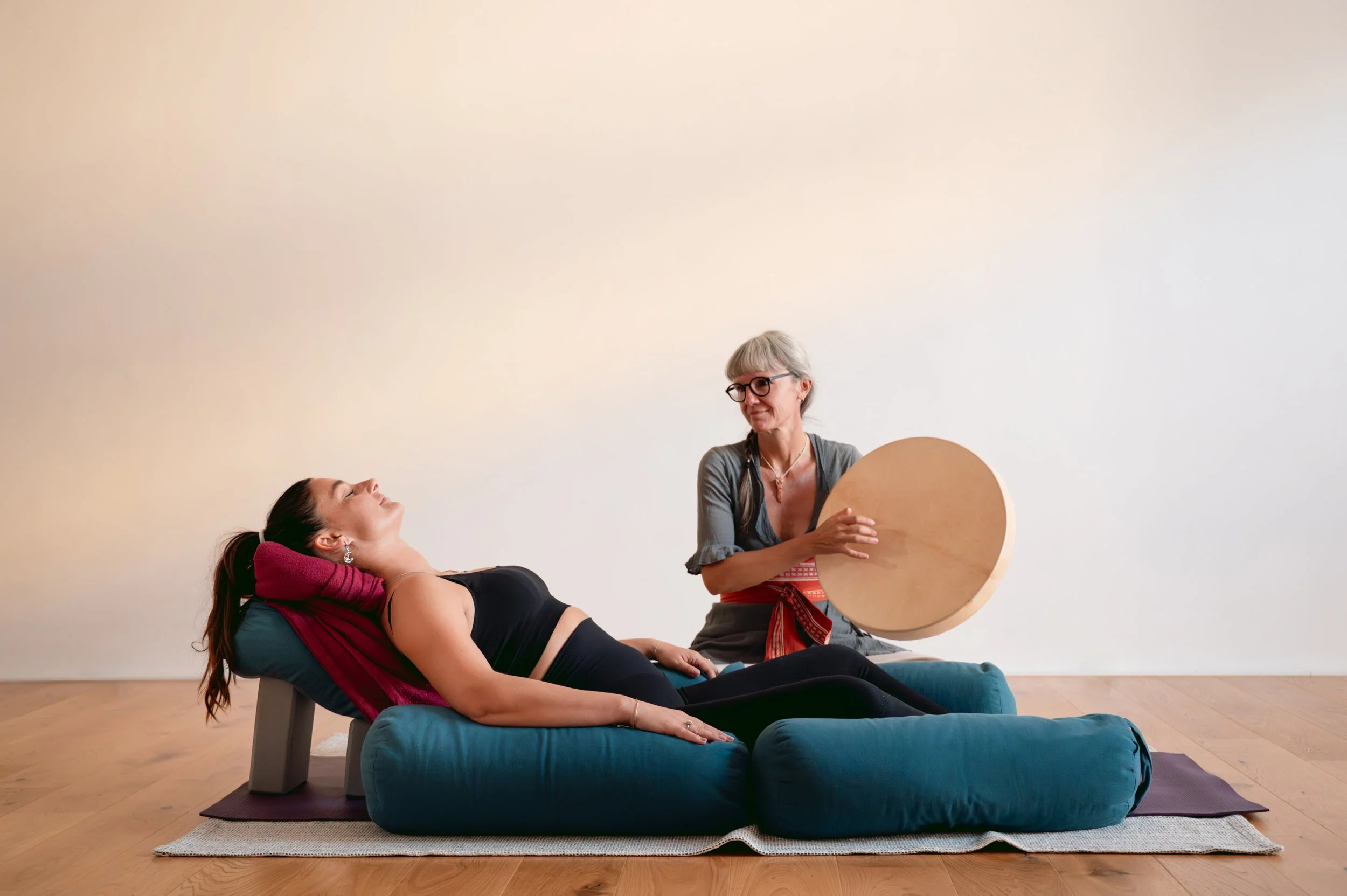
Somatic relief (Restorative Yoga): Passive, supported postures that induce deep relaxation and a gentle trance. Learn more here
Womb focusing: A breath-guided listening practice that brings attention into the womb to welcome what has not yet found a voice and, once recognised, can begin to move. Learn more here
Sobada womb massage: A manual massage from the South American tradition that releases pelvic tension and restores openness and lightness to the womb. Learn more about Sobada massage
Drum medicine: The ancestral rhythm that accompanies states of light trance, deep listening and vision, evoking the first heartbeat known to every body.
Benefits
Mind: Mental clarity · Intuition · Calm
Body: Deep relaxation · Openness · Grounding · Energy
Heart: Self-trust · Resilience · Self-care
Grembosofia accompanies women
In sensing and in the self
Awakens feminine consciousness, vision, creativity and imagination
Strengthens self-trust and the ability to make decisions
Deepens a woman’s awareness of her own uniqueness
At the thresholds of the female body
Accompanies fertility in its natural time
Supports pregnancy as listening and connection
Helps to regain energy in the postpartum period
Eases menstrual pain
Accompanies the time after an abortion
Welcomes menopause with serenity
Voices of women who have experienced the Grembosofia method
“Our bodies hold knowledge and archetypes that can guide us in healing, and that, sadly, we have been taught to ignore.
Taking part in the sessions with Ilaria allowed me to listen to this voice of my body, a voice both ancient and present, which was waiting to be discovered through hands-on practice, art and sharing.”
“Care. This is the message that is gently moving within me, after a second cycle of meetings with Ilaria.
This time the focus was on the womb, an unexpected discovery of a new place of care. Journeys of the soul.”
“Thank you, thank you, thank you to Ilaria, keeper of a dreamtime that allows each of us to create a moment in which to give nourishment, attention and repair to our own inner worlds and invisible layers.”